
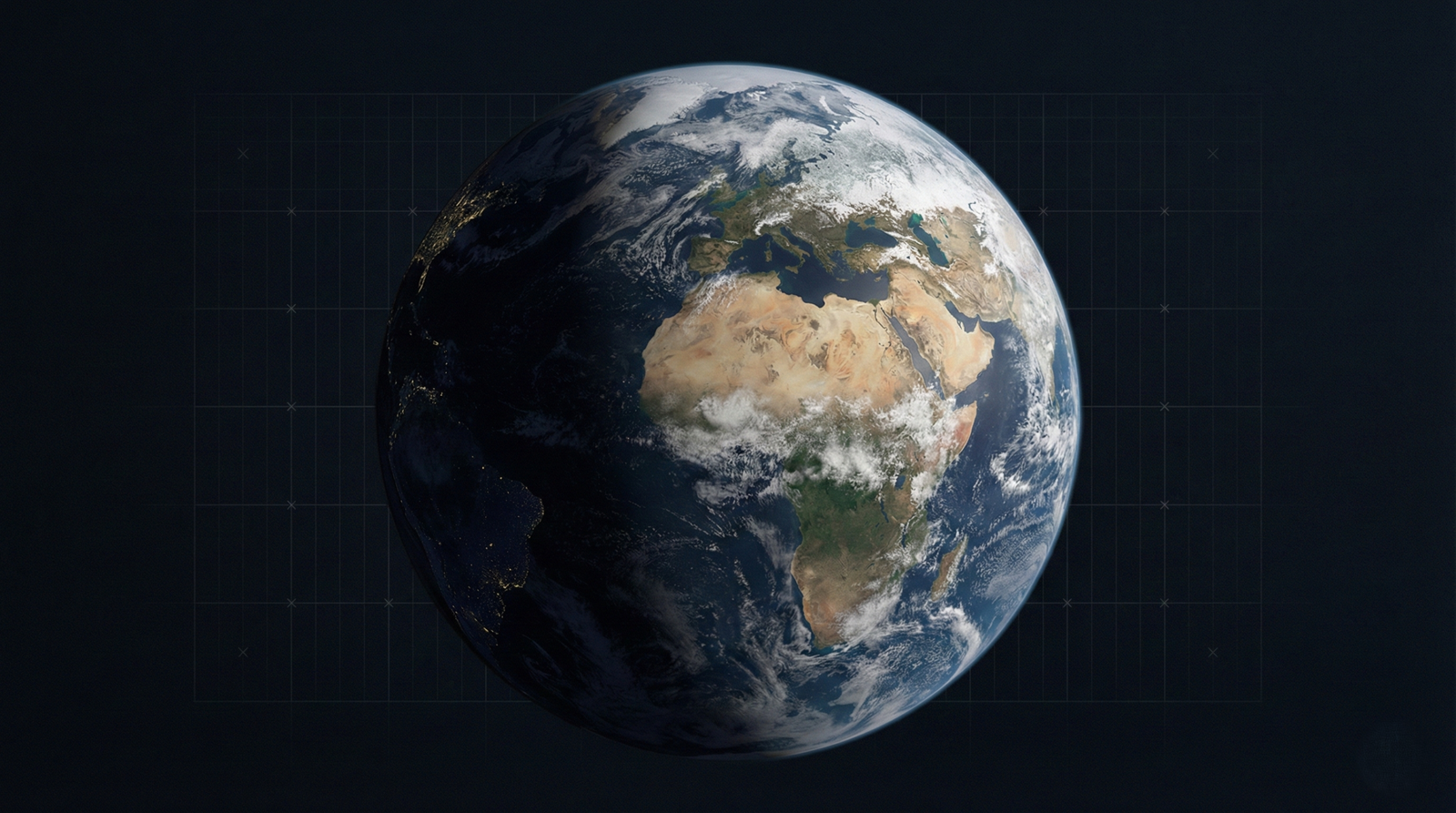
Earth’s rotation is one of the most constant features of life. Every sunrise, every weather system, and every biological rhythm quietly depends on it. The planet turns once every twenty four hours, distributing sunlight, regulating temperature, and shaping atmospheric motion. Because this motion is so stable, it is easy to forget how deeply life depends on it.
This article explores a scientific thought experiment. What would happen if Earth suddenly stopped spinning, while gravity, atmosphere, and orbit around the Sun remained unchanged. The goal is not speculation about causes, but an examination of consequences under known physical laws.
Earth’s Rotation and Why It Matters
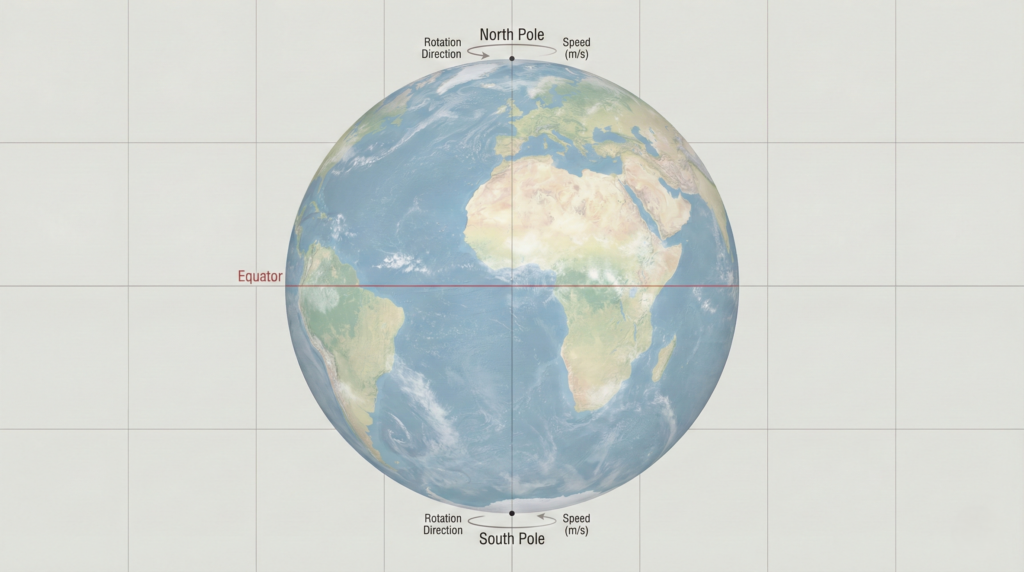
Earth rotates eastward around its axis at a speed that varies by latitude. At the equator, the surface moves at roughly 1670 kilometers per hour. At higher latitudes, the speed gradually decreases until it reaches zero at the poles.
This rotation does more than create day and night. It shapes wind patterns, drives ocean currents, stabilizes climate zones, and slightly alters the planet’s shape. The Coriolis effect, produced by rotation, causes moving air and water to curve, organizing global circulation.
Life has evolved within this rotating framework for billions of years. Removing it would not simply slow time. It would unravel a system that depends on motion to remain balanced.
The Instant Rotation Stops
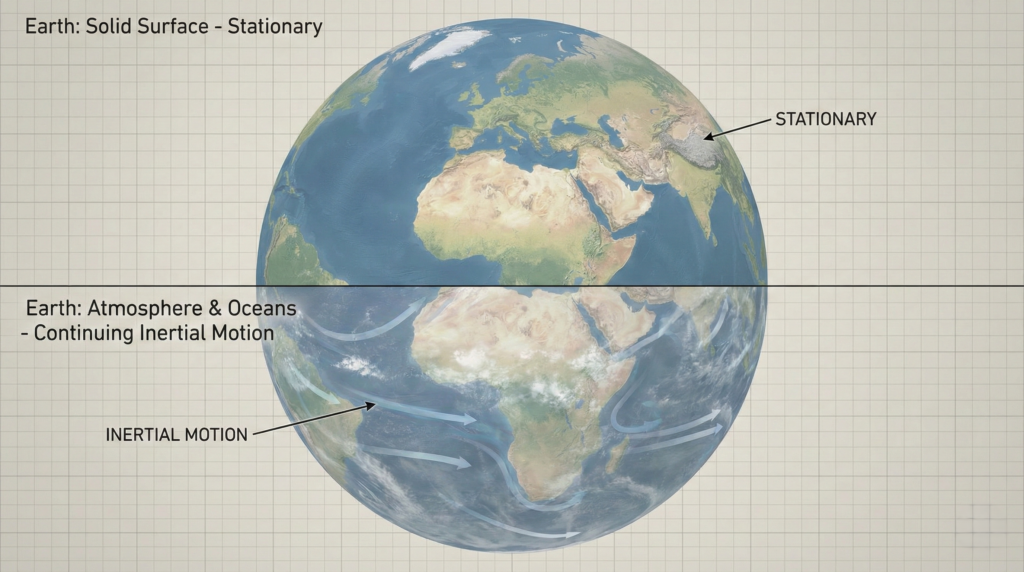
If Earth’s rotation halted suddenly, the surface would stop moving, but everything not rigidly attached to the planet would continue moving eastward due to inertia. This persistence of motion follows the conservation of angular momentum, a fundamental principle of physics.
The atmosphere, oceans, and loose objects would retain their rotational velocity.
Near the equator, this would translate into winds moving faster than the speed of sound. Buildings, forests, and surface structures would be overwhelmed within minutes. Oceans would surge across continents, reshaping coastlines violently.
This is not an explosion or impact event. It is inertia acting on a planetary scale, releasing energy that had been silently stored in motion.
Atmospheric Inertia and Wind Speeds
Air does not stop instantly when the ground beneath it halts. As the atmosphere races eastward, pressure differences would create shock fronts and extreme turbulence.
These winds would erode landscapes, flatten vegetation, and carry debris across vast distances. Even regions far from the equator would experience destructive forces as the atmosphere redistributed its momentum.
Most surface life would not survive this initial phase.
Ocean Momentum and Global Flooding
Oceans contain enormous kinetic energy. When rotation stops, water continues moving eastward, piling against continents and flooding inland areas.
Some regions would be submerged under kilometers of water, while others would be left exposed as ocean basins partially emptied. Coastlines as we know them would vanish.
The redistribution of water alone would permanently reshape Earth’s geography.
After the Chaos Settles
After the initial destruction, the atmosphere and oceans would eventually slow through friction and energy loss. Earth would reach a new equilibrium, but it would be a profoundly altered world.
The most immediate long term change would be the disappearance of the daily cycle.
A Year Long Day and Endless Night
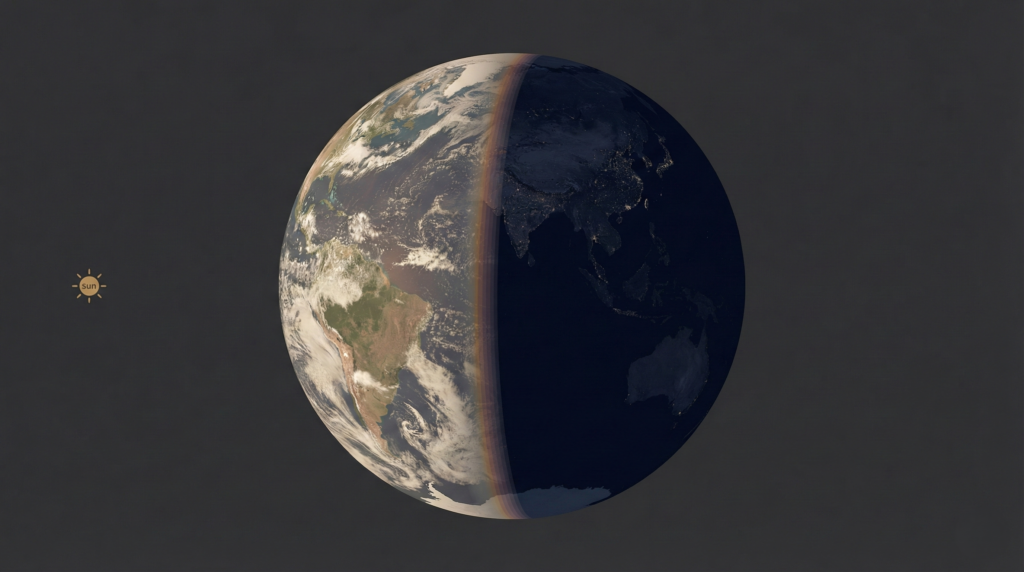
Without rotation, Earth would still orbit the Sun once per year. One hemisphere would face the Sun continuously for months, while the opposite hemisphere would remain in darkness for the same duration. This extreme contrast would amplify Earth’s dependence on continuous solar energy, highlighting how critical sunlight is to planetary stability.
Temperatures would diverge dramatically.
- The sunlit side would heat relentlessly, drying landscapes and intensifying evaporation
- The dark side would cool toward extreme cold, freezing oceans and solidifying the surface
Between them, a narrow twilight region would exist where temperatures fluctuate enough to allow limited stability.
This boundary would slowly migrate as Earth moved along its orbit.
The Collapse of Familiar Weather Systems
Earth’s weather relies on rotation to distribute heat efficiently. The Coriolis effect organizes winds into predictable patterns, creating trade winds, jet streams, and storm tracks. This deflection arises from Earth’s rotation and is formally known as the Coriolis effect.
Without rotation:
- Jet streams would disappear
- Large scale circulation cells would collapse
- Weather would become slower, more extreme, and less predictable
Heat would move primarily through direct pressure differences rather than organized flow. Storms would form differently, and seasonal patterns would be replaced by prolonged extremes.
Gravity, Shape, and the Long Term Redistribution of Water
Earth’s rotation causes the planet to bulge slightly at the equator. This reduces effective gravity there and helps keep oceans evenly distributed. Earth’s long-term balance is also influenced by gravitational forces that shape tides and contribute to the stability of Earth’s orientation in space.
When rotation stops:
- The equatorial bulge would slowly relax
- Gravity would become more uniform across latitudes
- Water would gradually migrate toward lower gravitational potential near the poles
Over thousands to millions of years, oceans would redistribute, leaving equatorial regions drier and polar regions deeper.
These changes would occur slowly, but they would permanently alter the planet’s surface.
Biological Consequences and the Limits of Survival
Life would face challenges on multiple timescales.
Most surface organisms would perish during the initial atmospheric and oceanic shock. Survivors would be limited to protected environments such as deep oceans, underground ecosystems, or regions near the twilight boundary.
Over long periods, some life could adapt to extreme temperature gradients and prolonged light cycles. Photosynthesis would occur only on the sunlit side, while the dark side would rely on chemical or geothermal energy.
Earth would not become lifeless, but biodiversity would be drastically reduced.
A World Without Rhythms
Rotation provides more than motion. It provides rhythm.
Day and night cycles regulate sleep, growth, migration, and metabolism. Seasonal changes coordinate reproduction and ecological balance. Without rotation, these rhythms would disappear.
Earth would become a planet defined by extremes rather than cycles. Stable zones would shrink. Transitions would slow. The planet would still exist, but it would no longer feel alive in the way we recognize.
Earth stopping its rotation would not destroy the planet outright, but it would quietly remove one of its most important stabilizing mechanisms. The immediate release of atmospheric and oceanic momentum would devastate the surface, while long term changes would reshape climate, geography, and biology.
Rotation does not announce itself, yet it governs nearly every system that allows life to persist. By imagining its absence, we see how much of Earth’s habitability depends not on dramatic forces, but on steady, invisible motion.
Visual Exploration of the Scenario
This scenario has also been explored visually through a cinematic scientific simulation, illustrating the physical processes described above.
Disclaimer:
This article explores a scientific thought experiment using established physical principles. The scenario described is not a prediction and does not represent a realistic future even.