For most of human history, the Moon has been a constant presence in the sky. It rises and sets with quiet regularity, shapes calendars, guides tides, and has influenced science, culture, and navigation. Because it feels so familiar, it is easy to overlook how deeply the Moon is woven into Earth’s physical systems.
But what if that presence suddenly vanished? Not exploded, not pushed away, but simply disappeared. No warning. No gradual retreat. Just gone.
This question is more than a curiosity. The Moon is not just a companion in space. It plays an active role in stabilizing Earth’s motion, shaping its oceans, and influencing long term climate patterns. Removing it would not destroy Earth overnight, but it would quietly and fundamentally alter the planet’s future.To understand what would happen, we need to examine the Moon’s role first, and then trace the consequences of its absence step by step.
The Moon’s Role in Earth’s System
Gravitational influence
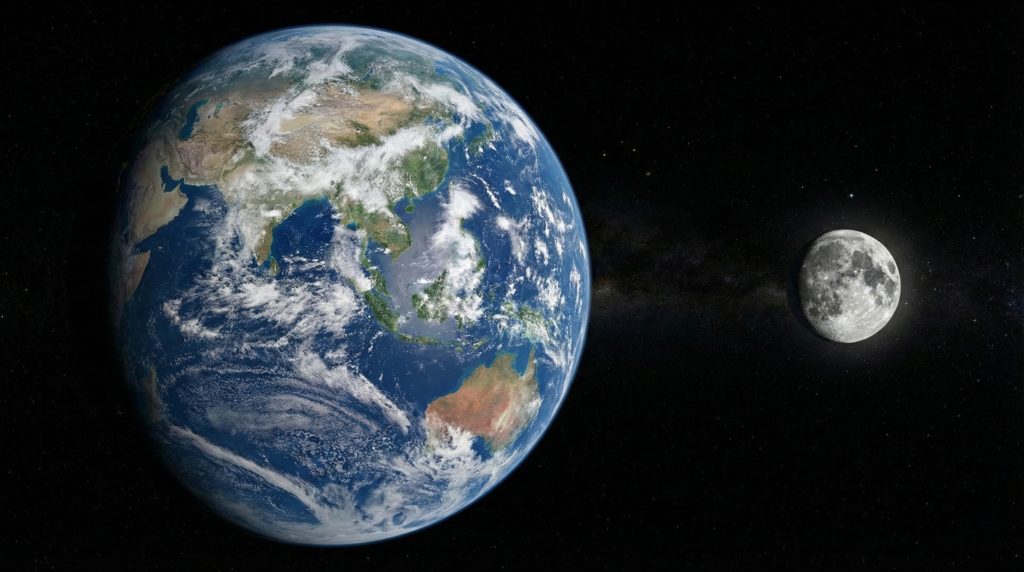
The Moon is massive enough to exert a significant gravitational pull on Earth. While the Sun is far larger, the Moon’s proximity gives it a strong influence over certain Earth systems, particularly the oceans. This interaction is not static. As the Moon orbits Earth, its gravity creates rhythmic changes that shape coastlines and support marine ecosystems.
Beyond tides, the Moon also affects Earth itself. The solid surface of the planet rises and falls slightly under lunar gravity. These movements are subtle, but over long periods they influence how energy is transferred within Earth’s system.
The Moon also exchanges angular momentum with Earth. This slow interaction affects Earth’s rotation speed and contributes to long term stability in how the planet spins through space.
Orbital partnership with Earth
Earth and the Moon form a connected system rather than a simple planet and satellite relationship. Both bodies orbit a shared center of mass, which lies just beneath Earth’s surface. This relationship subtly influences Earth’s orientation and rotation over geological timescales.
Most importantly, the Moon helps stabilize Earth’s axial tilt. That tilt determines how sunlight is distributed across the planet and is responsible for the seasons. Without this stabilizing influence, Earth’s orientation would be far more sensitive to gravitational disturbances from other planets.
What Happens Immediately After the Moon Disappears
Changes in gravity
If the Moon disappeared instantly, Earth would not experience a dramatic physical shock. There would be no global earthquakes triggered directly by its absence. The planet would continue spinning and orbiting the Sun as before.
However, the gravitational field around Earth would change immediately. The Moon’s pull on the oceans, atmosphere, and crust would vanish. Objects on Earth would weigh slightly less, although the difference would be too small for humans to notice without precise instruments.
Immediate effects on tides
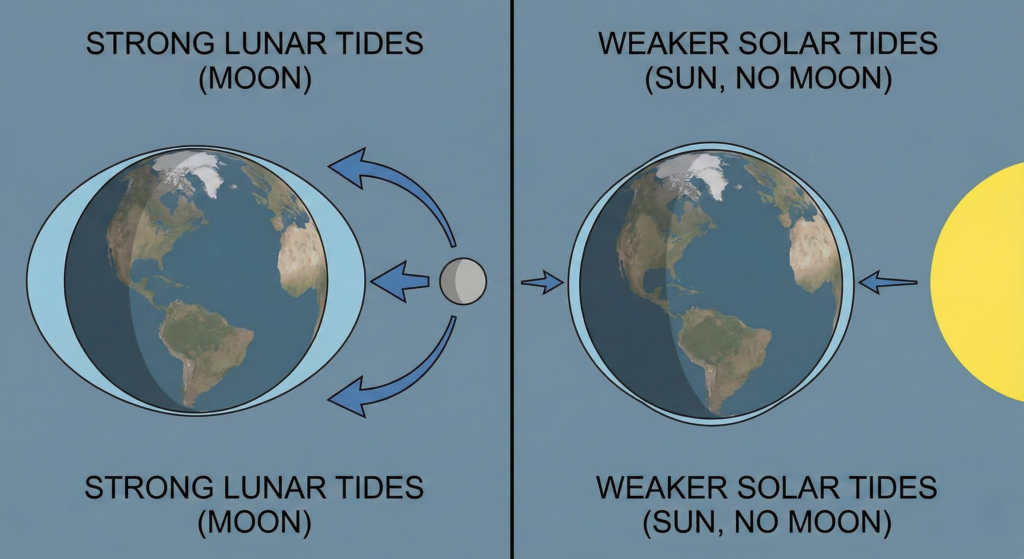
The most noticeable short term change would occur in the oceans. Lunar tides would collapse within hours. What remained would be solar tides, driven by the Sun’s gravity, which are significantly weaker.
In many coastal regions, the difference between high tide and low tide would shrink dramatically. Shorelines that rely on strong tidal movement would begin adjusting almost immediately.
How Earth’s Oceans and Tides Would Change
Tides would not disappear completely
Without the Moon, tides would still exist, but they would be much smaller. The Sun’s gravitational influence would continue to raise and lower sea levels, though with far less intensity.
Tides play a crucial role in mixing ocean waters, distributing nutrients, and regulating coastal temperatures. Weaker tides would reduce this mixing, especially in shallow seas and estuaries.
Coastal and ecological consequences
Many marine ecosystems depend on strong tidal cycles. Mudflats, salt marshes, and estuaries exist because tides regularly flood and expose these environments. With reduced tidal ranges, many of these habitats would shrink or change location.
Marine species that rely on tidal timing for feeding or reproduction would face disruption. Over time, ecosystems would adapt, but the transition would be difficult for species already living close to environmental limits.
The Long Term Impact on Earth’s Rotation and Stability
Axial tilt without the Moon
Earth’s axial tilt is currently stable within a narrow range. The Moon plays a key role in maintaining that stability. Without it, Earth’s tilt would become more vulnerable to gravitational interactions with other planets, especially Jupiter.
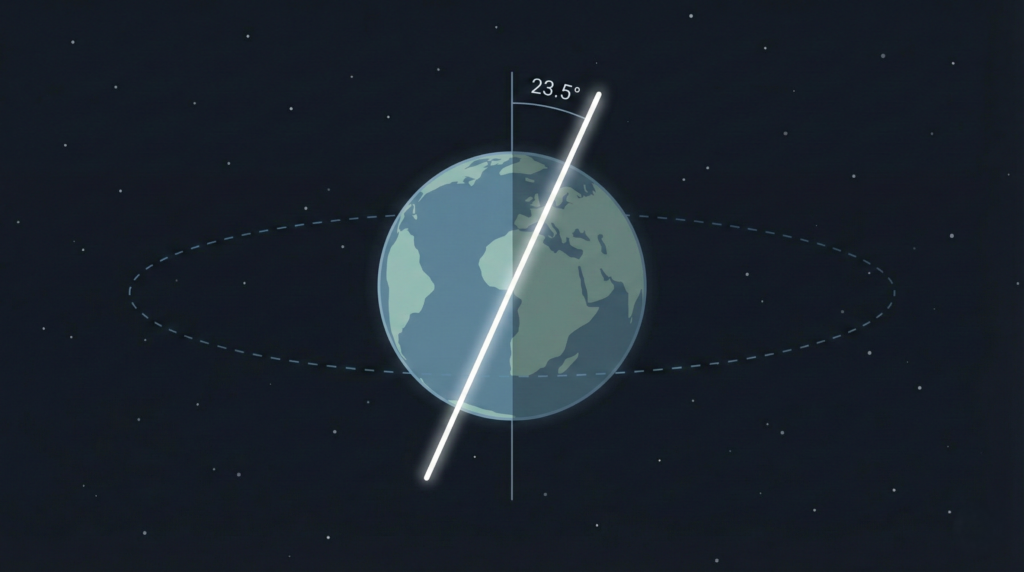
Over millions of years, Earth’s tilt could swing between much larger and smaller angles. These changes would alter the intensity of seasons and redistribute sunlight across the planet in unpredictable ways.
Climate variability over deep time
Greater tilt variation would lead to stronger climate fluctuations. Some regions could experience extreme seasonal contrasts, while others might lose well defined seasons entirely.
Earth would remain a living planet, but its climate system would become less consistent over geological timescales, placing additional pressure on ecosystems and long term biological stability.
Effects on Life and Ecosystems
Marine life would feel the fastest impact
The earliest biological consequences would appear in the oceans. Reduced tidal mixing would change oxygen levels, nutrient flow, and coastal productivity.
Some species would decline, while others adapted to calmer waters might expand. The overall structure of marine food webs would gradually reorganize.
Loss of lunar biological timing
Many organisms respond to lunar cycles, not only through tides but also through moonlight. Reproductive cycles, migration patterns, and nighttime behavior are often linked to the Moon’s phases.
Without the Moon, these natural cues would disappear. Over time, species would adapt to new rhythms, but the loss of a predictable lunar cycle would reshape many ecological relationships.
Could Earth Remain Habitable Without the Moon?
In the short term, Earth would remain fully habitable. The atmosphere would stay intact, gravity would remain strong, and oceans would not disappear. Human life could continue without immediate threat.
In the long term, the issue is not survival but stability. A planet with weaker tides and a more variable axial tilt would experience greater environmental uncertainty over deep time.
This highlights Earth’s dependence on stable cosmic conditions, similar to the role explored in What If the Sun Went Out for 24 Hours?, where long term balance also proves more important than immediate survival.
Visual Exploration of the Scenario
This scenario has also been explored visually through a cinematic scientific simulation.
The Moon’s disappearance would not cause instant destruction, but it would quietly remove one of Earth’s most important stabilizing influences. Tides would weaken, ecosystems would reorganize, and over long periods of time Earth’s climate would become more variable.
The Moon may appear passive in the sky, yet it plays an active role in shaping the conditions that allow life to persist with relative balance. If removing a single familiar object can alter a planet’s future so deeply, it raises a broader question about how many unseen stabilizers may exist on worlds beyond our own.
Disclaimer:
This article is for educational purposes and explores a scientific thought experiment using established physics and Earth science.